Lal Diary — Android Personal Finance & Udhaar Management Application
Lal Diary is an offline-first Android app by NetGram Labs for managing personal finances and udhaar. Track money given, borrowed, received, and paid, manage contacts, monitor balances and due dates, and export records to CSV or Excel. With local data storage and optional PIN protection, Lal Diary makes everyday money management simple, private, and organized.
Technology Stack
React NativeExpoTypescript
Project Overview & Technology
Lal Diary — Android Personal Finance & Udhaar Management Application
Project Overview
Lal Diary is an Android personal finance and udhaar management application developed by NetGram Labs. It helps users maintain a clear record of money given to others, money borrowed, payments received, and amounts paid.
Designed for everyday financial record-keeping, the application brings people management, transaction tracking, outstanding balances, payment reminders, and transaction history together in one place.
A key feature of Lal Diary is its offline-first approach. Financial records are stored locally on the user's device, allowing the app to work without an internet connection. Users can also protect access with an optional PIN and export their financial records to CSV or Excel for reporting and personal record-keeping.
With its clean red-and-black visual identity and straightforward interface, Lal Diary aims to make everyday money management simpler, more organized, and more convenient.
Image-1
Image-2
Image-3
About Lal Diary
Managing personal lending and borrowing can become difficult when transactions are spread across notebooks, messages, and memory. Remembering who borrowed money, how much was given, what has been repaid, and when a payment is due can quickly become confusing.
Lal Diary provides a digital alternative to traditional udhaar diaries.
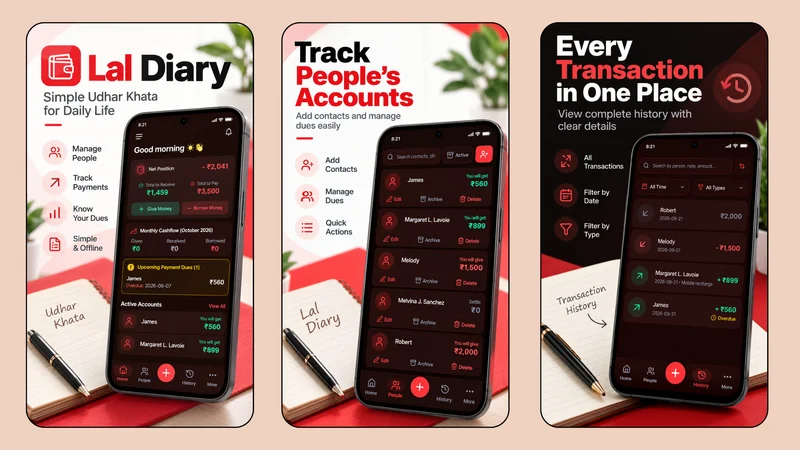
Users can maintain individual records for people, add financial transactions, review balances, and check their transaction history whenever needed. The application organizes these details into a central dashboard so users can better understand how much money they expect to receive and how much they need to pay.
Unlike services that depend on an online account for everyday access, Lal Diary is designed to keep its financial records on the user's device and support offline usage.
The main objective of Lal Diary is to simplify personal financial record-keeping without making it unnecessarily complicated.
The application focuses on the following goals:
Replace manual udhaar records with an organized digital diary.
Track money given, borrowed, received, and paid.
Maintain transaction records linked to individual people.
Calculate and present outstanding amounts clearly.
Help users identify upcoming and overdue payments.
Provide a complete, searchable transaction history.
Keep financial records available offline on the user's device.
Support local backup, restoration, and data export.
Offer a simple interface suitable for everyday use.
Main Features
1. Personal Financial Dashboard
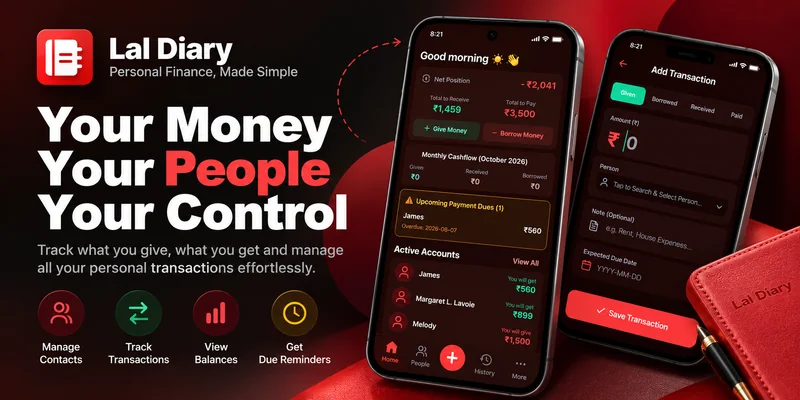
The home dashboard provides an overview of the user's financial position.
It brings important figures and account information together, helping users understand their current lending and borrowing records without manually calculating every amount.
The dashboard includes:
Net Position: An overview of the user's net lending and borrowing position.
Total to Receive: The amount recorded as receivable from others.
Total to Pay: The amount recorded as payable.
Monthly Cash Flow: A summary of recorded financial activity for the selected month.
Upcoming Payment Dues: A view of payments that are approaching or overdue.
Active Accounts: Quick access to people with recorded outstanding transactions.
This overview helps users review their financial records and identify which payments may require attention.
2. Add and Manage Transactions
Lal Diary allows users to record different types of money-related transactions.
When adding a transaction, users can select the transaction type, enter the amount, choose the associated person, and optionally add a note and expected due date.
Supported transaction categories shown in the app include:
Given: Money given or lent to another person.
Borrowed: Money borrowed from someone.
Received: Money received.
Paid: Money paid.
Each entry can include additional information to make the record easier to understand later.
This structure helps users maintain a more reliable record of everyday financial activity instead of relying on memory or informal notes.
3. People and Contact Management
The People section organizes financial records around individual contacts.
Users can maintain records associated with different people and review the amounts connected to each account.
This makes it easier to answer common questions such as:
Who has borrowed money from me?
How much have I given to a particular person?
How much money have I received back?
Which payments are still outstanding?
Which accounts need follow-up?
By linking transactions to people, Lal Diary makes personal lending and borrowing easier to manage.
4. Balance Tracking
The application presents recorded financial balances through the dashboard and individual account information.
Users can review amounts to receive and amounts to pay, helping them understand their outstanding financial commitments.
The net position overview provides an additional way to see the overall difference between recorded receivables and payables.
These features are particularly useful for people who regularly lend small amounts, borrow money, or manage multiple informal financial arrangements.
5. Upcoming and Overdue Payment Reminders
Lal Diary supports expected due dates for transactions and displays upcoming or overdue payment information.
When creating a transaction, users can enter an expected payment date. The dashboard can then highlight payment dues that require attention.
This helps users keep track of outstanding amounts and remember which transactions may need to be followed up.
6. Complete Transaction History
The History section brings recorded transactions together in one place.
Instead of opening individual records to reconstruct past activity, users can review their transaction history and examine the details of different entries.
The interface includes:
All-transactions view.
Search by person, note, or amount.
Date-based filtering.
Transaction-type filtering.
Clear presentation of transaction amounts.
Indicators for relevant payment statuses, including overdue records.
These options make it easier to locate a previous transaction and understand the context of a payment or lending record.
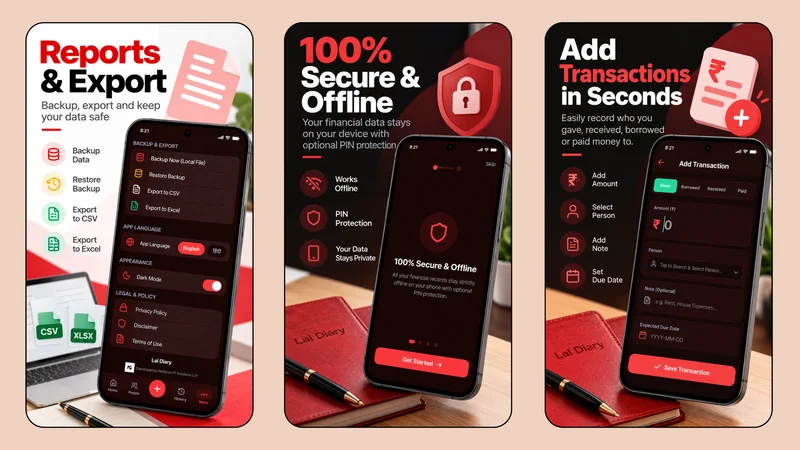
7. Offline Data Storage and Privacy
One of Lal Diary's defining characteristics is its offline functionality.
The app is designed to store financial records locally on the user's device, so users can continue managing their records without depending on an active internet connection.
The privacy-focused design includes:
Offline access to financial records.
Local storage of user data.
Optional PIN protection.
A privacy-oriented application experience.
This approach is especially relevant for users who prefer keeping personal financial information on their own devices rather than relying on an online account for everyday record access.
Users should still maintain their own backups and protect their devices, as locally stored information can be lost if a device is damaged, reset, or replaced.
8. Backup and Restore
Lal Diary includes backup and restore options to help users preserve their financial records.
The Backup & Export section provides options to create a local backup and restore a previously saved backup.
These features are important for personal finance applications because transaction history can contain information that users may need for future reference.
Regular backups can also help users prepare for device changes or unexpected data loss.
9. Export to CSV and Excel
The application supports exporting financial records to CSV and Excel formats.
These formats make it easier to keep separate copies of financial information, review records outside the app, and maintain personal documentation.
Export functionality is useful for users who want to:
Keep a spreadsheet of their transactions.
Review financial records on a computer.
Maintain an additional copy of important information.
Organize records for personal reference.
Work with exported data using compatible spreadsheet software.
The app also includes a restore option for supported local backups, helping users manage their saved records.
10. Language and Appearance Options
The application includes settings for customizing parts of the user experience.
The settings screen shows:
App language selection, including English and Hindi.
Dark mode appearance settings.
Backup and restore controls.
CSV and Excel export options.
Privacy policy, disclaimer, and terms of use.
These options help users configure the application according to their preferences while keeping essential financial management tools accessible.
User Interface and Design
Lal Diary uses a distinctive red-and-black visual theme with a dark interface, clear financial indicators, rounded panels, and prominent action buttons.
The design emphasizes readability and quick access to important actions. Users can identify the main financial figures on the dashboard and open key sections through the bottom navigation.
Dashboard Design
The dashboard prioritizes financial information such as net position, total receivables, total payables, monthly cash flow, payment dues, and active accounts.
This layout gives users a quick overview of their recorded financial activity.
Transaction Entry Design
The transaction form separates transaction type, amount, person, optional notes, and expected due date into distinct fields.
This structure makes the process of adding a financial record more organized and helps users understand which details are being saved.
History Design
The History screen uses transaction entries, filters, and search to help users find specific records.
Different visual indicators help distinguish incoming and outgoing amounts, while date and type filters make longer histories easier to navigate.
Visual Identity
The red accent color reinforces the Lal Diary brand, while the dark interface creates a consistent appearance across the dashboard, transaction forms, history, and settings.
The overall design aims to balance a recognizable identity with the practical needs of a financial record-management application.
Offline-First Approach
Offline access is an important part of Lal Diary's product design.
Users should be able to consult their records and maintain their financial diary even when mobile data or Wi-Fi is unavailable.
Keeping records on the device also reduces the need to send personal transaction details to a remote service for routine use.
The backup and export options complement this approach by giving users ways to preserve their information separately.
This combination of offline access, local data storage, optional PIN protection, and export functionality supports a more user-controlled approach to personal financial management.
Development Approach
The application brings together transaction management, people-based financial records, balance summaries, payment tracking, history, and data management features in a single Android experience.
The development priorities reflected in the product include:
Financial record management: Organizing lending, borrowing, receiving, and payment entries.
People-based records: Associating transactions with individual contacts.
Balance overview: Presenting recorded receivables, payables, and net position.
Payment tracking: Recording expected due dates and identifying overdue entries.
Transaction history: Making previous records easier to find and review.
Offline operation: Keeping financial records accessible without a continuous internet connection.
Data portability: Supporting CSV and Excel exports alongside backup and restore options.
User experience: Maintaining a consistent interface across the app's main sections.
Challenges Addressed
Managing Multiple Financial Transactions
Users may have several outstanding transactions with different people. A centralized transaction history and people-based records help organize this information and make individual accounts easier to review.
Understanding Outstanding Balances
Keeping track of what is owed and what must be paid can become confusing when records are maintained manually. The dashboard's receivable, payable, and net position summaries make these figures easier to review.
Preserving Financial Records Offline
A personal finance application should remain useful when the internet is unavailable. Lal Diary's local-storage approach supports offline access, while backup and export features give users options for preserving their information.
Finding Older Transactions
As the number of recorded transactions increases, finding a specific entry becomes more difficult. Search and date- and type-based filters help users navigate their history more efficiently.
Keeping the Interface Simple
Financial management tools need to present important information without overwhelming users. Lal Diary uses a dashboard-led layout, clearly separated transaction fields, and dedicated sections for people, history, and additional settings.
NetGram Labs Contribution
NetGram Labs developed Lal Diary as an Android application focused on everyday personal finance and udhaar management.
The product brings essential financial record-keeping capabilities together in one mobile application, with particular attention to offline usage, transaction organization, and user-controlled data management.
The project encompasses the following product areas:
Personal lending and borrowing management.
Transaction entry and history.
People-based financial records.
Receivable and payable summaries.
Net position and monthly cash-flow overview.
Expected payment dates and overdue indicators.
Local data storage and offline access.
Optional PIN protection.
Backup and restore functionality.
CSV and Excel export.
Language and appearance settings.
Android-focused user interface design.
Together, these capabilities position Lal Diary as a practical digital alternative to maintaining a handwritten udhaar diary.
Project Outcome
Lal Diary provides a centralized way to record and review personal lending, borrowing, payments, and outstanding balances on Android devices.
By combining people management, transaction history, balance summaries, due-date tracking, and data export, the application helps users organize financial information that might otherwise be scattered across notebooks or informal records.
Its offline-first design allows users to work with locally stored financial records without requiring a continuous internet connection. Backup and export features provide additional ways to preserve and manage that information.
The result is a personal finance application built around a simple idea: make everyday money tracking clearer, more accessible, and easier to maintain.
Project Highlights
Android application for personal finance and udhaar management.
Record money given, borrowed, received, and paid.
Manage financial records associated with individual people.
Dashboard with net position, receivables, and payables.
Monthly cash-flow overview.
Upcoming and overdue payment information.
Searchable transaction history.
Date and transaction-type filters.
Offline access with locally stored financial records.
Lal Diary helps users manage their personal lending and borrowing records through a dedicated Android application designed for convenient, offline financial record-keeping.
Developed by NetGram Labs
Building practical mobile applications and digital solutions for everyday needs.
Want a project built like this?
Our engineering team builds high-velocity websites, web apps, AI automations, and custom content systems. Let's talk about your project goals.